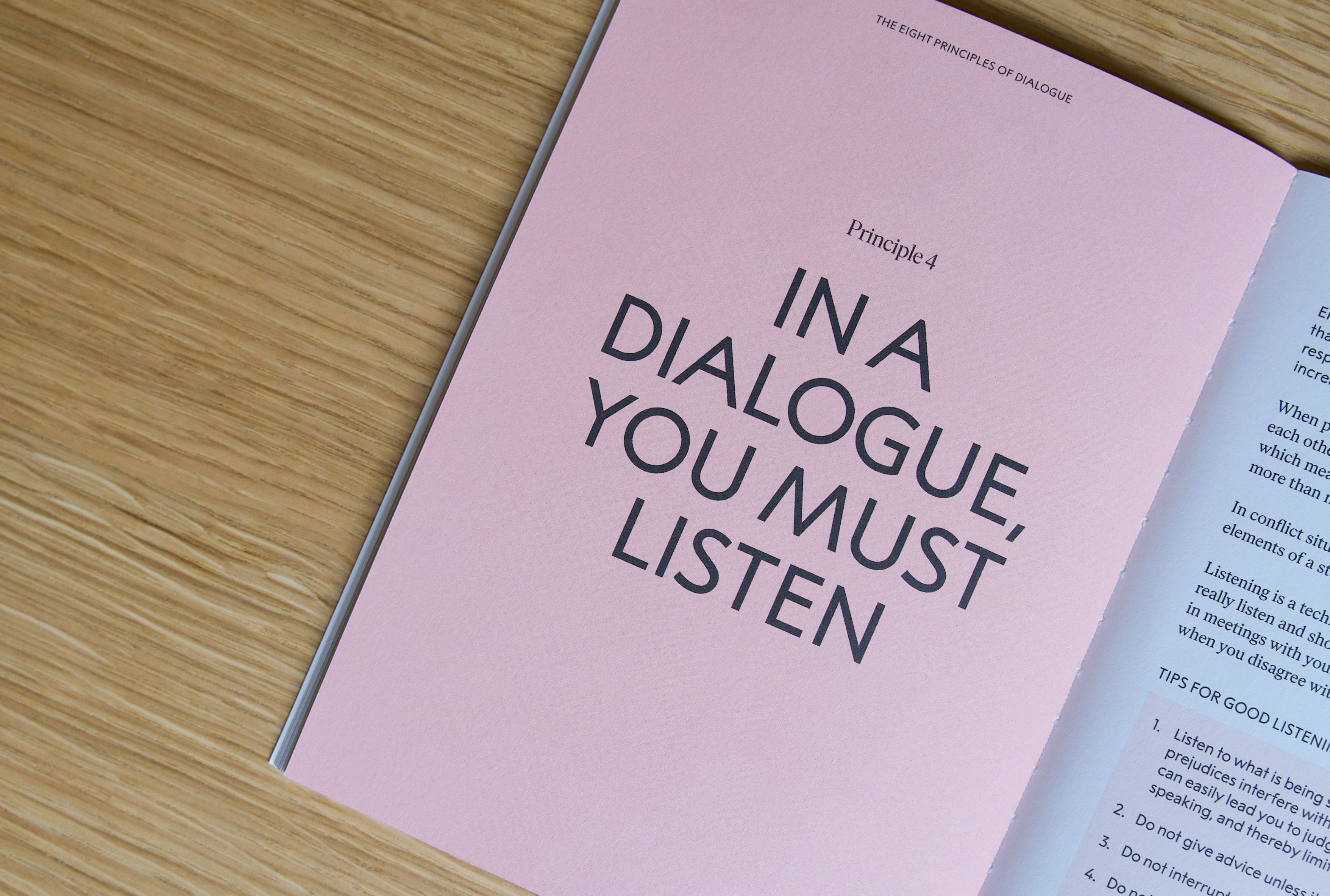
Principle 4: In dialogue you must listen
Listening is more than merely hearing, listening requires focus and presence.
Industriaksjonen and Natur og Ungdom used Principle 4
Industriaksjonen and Nature and Youth have long been opposites, but by listening to each other they managed to agree on ten principles for nature and for the jobs of the future principles both sides could support.

Tips for good listening:
- Listen to what is being said. Do not let your own thoughts and prejudices interfere with your ability to listen. Your perceptions can easily lead you to judge others long before they have finished speaking, and thereby limit your listening skills.
- Do not give advice unless it is requested.
- Do not interrupt. Let the other person finish talking.
- Do not capture the conversation by drawing parallels to your own experiences, example: “I have experienced that too!”. Allow the other person their time; you will get yours.
- Be empathic and show understanding for the other person’s situation. Being empathic means that you understand the others’s feelings, without necessarily feeling them yourself.
- Do not presume to know other people’s opinions.

Discrimination made illegal thanks to peaceful demonstrations and speeches
When those in power refused to listen, Peace Prize laureate Martin Luther King Jr. used Principle 4: In dialogue, you must listen to find a solution. In 1963, 250,000 people demonstrated peacefully, and Martin Luther King Jr. delivered a speech that likely helped pave the way for a law the following year that made racial discrimination illegal in the United States.

What are the dialogue principles?
The eight dialogue principles were defined when we tried to understand how the Peace Prize laureates managed to move their causes forward in such a peaceful and productive way. We realised there is a pattern in their approach. Dialogue is the overarching concept, while the principles are parts of dialogue that anyone can practise.